JT Atkinson
Increase in Klaviyo flow revenue with expert management.
If you’re an eCommerce brand using Mailchimp, one of the most common questions we get is if it’s time to move to Klaviyo. In most cases, brands begin exploring the switch when they start feeling limitations within their current setup, whether that’s weaker automation, limited segmentation, reporting frustrations or simply not being able to achieve the level of retention performance they’re aiming for. This guide walks through the key differences between Mailchimp and Klaviyo, alongside the commercial and operational considerations worth evaluating before making the move.
Mailchimp
Best suited to smaller businesses, newsletters and brands with simpler email marketing needs. Ideal for basic campaigns, lighter automation and businesses where email is not yet a major retention or revenue channel.
Klaviyo
Best suited to growing DTC and eCommerce brands focused on retention, automation and customer lifetime value. Stronger for advanced segmentation, behavioural flows, SMS marketing and revenue-driven customer journeys built around real-time store data.
Let’s delve deeper into specifics of each platform.
In our opinion, the liklihood is many eCommerce brands eventually outgrow Mailchimp at some point. Retention naturally becomes a bigger revenue driver, exposing some limitations around automation, segmentation, reporting and customer data start becoming more and more noticeable – especially with some platforms like Shopify.
We see brands move from Mailchimp to Klaviyo when common restrictions arise:
For brands where email and SMS are serious growth channels, these limitations can quickly hold performance back.
A key compatibility function within Klaviyo is being built around real-time eCom data, not just contact lists. Klaviyo will pull in live customer behaviour, purchase history, browsing activity and order data – directly from your store.
This allows eCom brands on Klaviyo to create more dynamic flows, segmentation and reporting which opens up the ability to react quicker to customer actions.
Mailchimp mainly segments contacts, Klaviyo is designed to segment customers. The difference may sound subtle but it allows more advanced retention strategies:
This gives eCom brands on Klaviyo a higher advantage – giving more powerful foundations or automation, retention and long term revenue growth in our opinion.
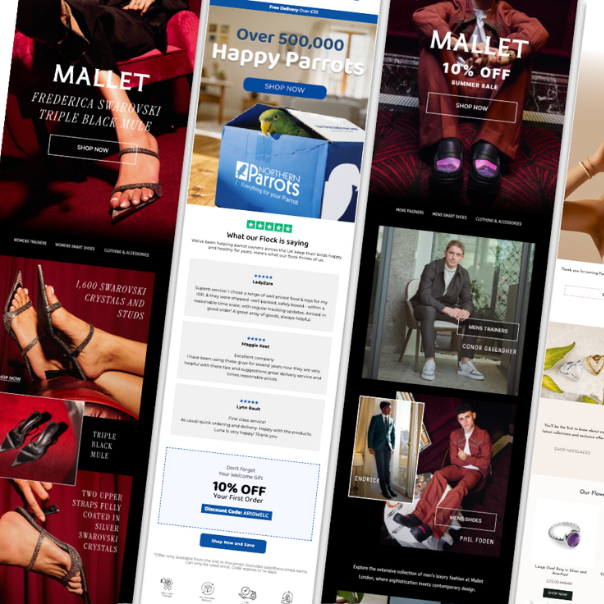
Klaviyo flows are a key feature within the ESP, automations do appear within Mailchimp but between the two there is a substantial gap. We’ve touched on segmentation on why this is beneficial but what can advanced customer journeys look like within Klaviyo?
Mailchimp can handle some of these at a basic level, it’s the advanced flexibility where Klaviyo often wins. This is achieved through advanced logic and specific segmentations.
Klaviyo’s predictive analytics gives brands forward-looking customer insight, including predicted next purchase date, estimated lifetime value, churn risk and expected order value.
This changes retention strategies – it allows brands to become more proactive rather than reactive. Confidence needs to lie within the data and over time you will be able to benchmark predictive vs. actuals
Creating smarter automations and campaigns will often feel more personalised to the user, which comes with the benefit of better open rates, click rates and ultimately purchases – without an increased risk of fatigue or send-ability issues.
Both email and SMS is housed under Klaviyo – one single account allows you to keep customer profiles, segmentation and behaviour data connected over multiple channels.
Having a joined up customer journey is exceptionally beneficial especially when one of the channels is SMS – this is a more intrusive channel and when done in isolation, the risk of additional frustration can be elevated. SMS can be a major player in retention and revenue; having them managed together becomes a strategic and operational advantage against other brands not adopting this unification.
The most common hesitation we hear from brands considering the switch is concern about disruption. A migration done properly is low risk. Done poorly, it can affect deliverability, list health and flow continuity. In reality, migration couldn’t be simpler – especially when you factor in expert help such as our Klaviyo agency services.
Before migrating anything, we audit the existing Mailchimp setup. This covers list hygiene, suppression status, engagement history, automation logic and any integrations that will need to be rebuilt or reconfigured.
Moving a clean, well-structured list into Klaviyo is a smooth process. Moving an unclean one creates problems you then have to solve in the new platform.
We clean and segment the list before import. Active, engaged subscribers transfer cleanly. Unengaged contacts are assessed against suppression history and spam complaint rates before any decision is made about whether to import them at all.
Protecting deliverability from day one in Klaviyo is more important than maximising list size.
We don’t mirror Mailchimp automations directly into Klaviyo. Migration is an opportunity to build flows properly. Each automation is rebuilt from scratch using Klaviyo’s native capabilities, with the right triggers, conditional logic and timing based on your actual customer data.
If your sending volume is significant, we build in a sending warm-up period. This protects domain reputation during the transition and ensures inbox placement is established correctly before full volume sending begins.
Store integration, conversion tracking and revenue attribution are all verified before go-live. We don’t consider a migration complete until revenue is attributing correctly and all flows are confirmed live with accurate data flowing through.
We are a certified Klaviyo partner agency. Klaviyo pays us a commission when we refer or manage accounts. We don’t keep it.
The commission we receive from Klaviyo is passed directly back to our clients. Depending on the arrangement, this either offsets your monthly management invoice or comes in the form of a period of free management. We’re transparent about this because we think it’s the right way to operate and because it changes the commercial dynamic in a way that genuinely benefits you – we don’t let commission get in the way of our objective thinking on what is best for your business.
When we recommend Klaviyo, it’s because it’s the right platform for eCommerce brands at growth stage. The partner commission is a consequence of that recommendation, not the reason for it. We want you to have confidence that the advice you’re getting is grounded in what’s best for your business.
Mailchimp is still a good fit for some businesses, particularly smaller brands, content-led newsletters or companies with simpler email marketing requirements where cost is the main priority.
We typically recommend considering Klaviyo when:
For growing eCommerce brands, this is usually the point where Klaviyo starts offering far more long-term value and scalability.
We're here if you have anything specific to ask; we've got a real passion for email marketing and helping businesses succeed, regardless of the ESP.
We love helping businesses win with Klaviyo, if you want to speak to our experts on how we can help you deliver more revenue, sustainably, put your details in.
Claim your free Klaviyo Audit